Showing posts with label buildings. Show all posts

Thursday, September 17, 2009

Narodni Dom

Narodni Dom (National House), also known among the Italians as the Hotel Balkan, is a building in Piazza Oberdan constructed in 1904 to a design by architect Max Fabiani.

Now it hosts the Scuola Superiore per Interpreti e Traduttori di Trieste. In the past it has hosted a theatre, a hotel, a bank, a restaurant, a cafè and it used to be the cultural centre of Triestine Slovenians.

During the 1920s and 1930s the Slavic population was subjected to forced Italianization and discrimination under the Italian Fascist regime. They were also exposed to state sponsored violence by fascist party mobs.

On July 13 1920, the fascist squads burnt down the building and prevented the fire brigade from putting the fire out, while the people inside the building were jumping out of the windows to flee from the blaze.


Tuesday, September 1, 2009

Hotel Riviera & Maximilian's

This outdoor lift, linking a hotel to the bathing resort below, is a real eyesore for lovers of the coast.

Thursday, August 27, 2009

Curtain of light

The windows of the General Registry Office are lit up by the sun as it is setting, and their reflection adorns the facade of a historic building.

Monday, August 10, 2009

4 in a row

From left to right: the People's Library, the seventeenth century Church of Beata Vergine del Rosario, the eighteenth century Marenzi palazzo and at the very back the modern facade of the General Registry Office (1954-58).

Thursday, August 6, 2009

Salone degli incanti

One of the entrances of the former fishmarket.

Saturday, August 1, 2009

Court house

Sunday, July 26, 2009

Province Headquarters

Thursday, July 23, 2009

Lego

Via Piccardi

Monday, July 20, 2009

Old and new

Sunday, July 19, 2009

Do you see what I see?!

Wednesday, July 8, 2009

Toy building

Friday, July 3, 2009

Skywatch Friday post

Post modern buildings

See more Skywatch here.

Tuesday, June 30, 2009

Smooth leg

Detail of the Chamber of Commerce seen last Saturday.

Monday, June 29, 2009

Inside

Entrance hall of an elegant house in Piazza Venezia.

Saturday, June 27, 2009

Chamber of Commerce

The Chamber of Commerce headquarters is one of the most significant examples of Triestine Neoclassicism and one of the most remarkable architectural works of the golden age of the Free Port of Trieste.

The building is in the style of a Doric Greek temple, whose spacious portico has four large columns and a tympanum at the top.

Thursday, June 11, 2009

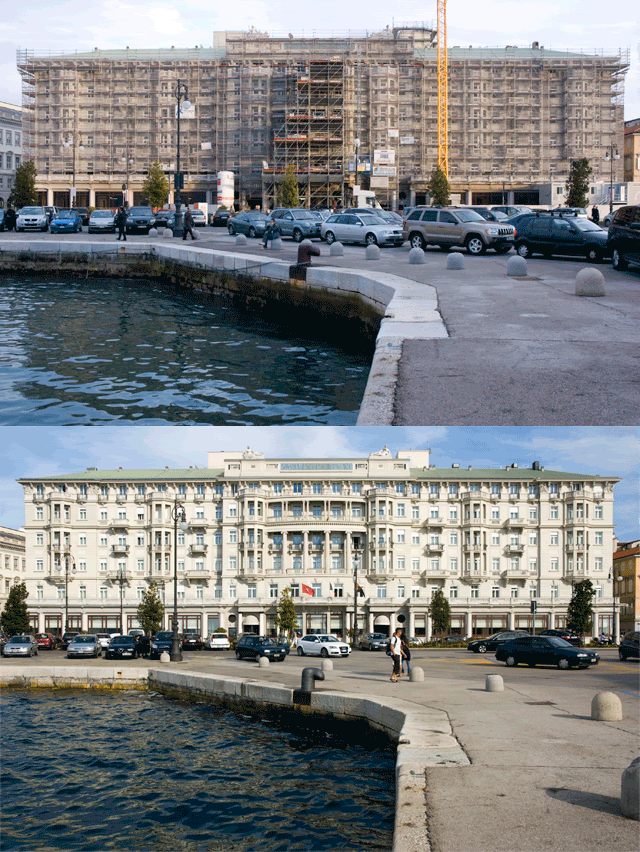
Et voilĂ 

When it was first inaugurated in 1912, the Excelsior Palace Hotel, was considered "... the most important and luxurious hotel in the Austro-Hungarian Empire...".

Sunday, June 7, 2009

Sala Tri*POP*vich

Formerly a coach station, this hangar-like terminal was converted into a theatre when the Verdi Opera House was undergoing restoration.
Today, a sizable group of Triestines organized via Facebook are suggesting that the Sala Tripcovich should be used for NON classical music, i.e. POPular music in all its forms.

What a great initiative!

Wednesday, June 3, 2009

Tergesteo (2)

Inside the Tergesteo Palazzo is a gallery which is open to the public; this relatively modern building presents this gallery in the style of the ancient Roman forums, with their covered crossroads where the ancient civilizations carried out their public life.

This photo is a few months old. Only part of the gallery is open at present, as work has begun to renovate the building.

Tuesday, June 2, 2009

Tergesteo

The Tergesteo Palazzo was built between 1840 and 1842 as a place for trade and where the local population could meet up and socialize.


The statue group standing on the facade overlooking Piazza della Borsa was sculpted by Pietro Zandomeneghi.

In the middle is the city of Trieste represented figuratively by the sea goddess Tetide, standing on a shell drawn by four horses rearing out of waves from the sea: the allegory of the sea on which the city's fortune is based is very clearly expressed.

(to be continued)


Saturday, May 9, 2009

The importance of symbols


Piazza Oberdan, the square in which the museum of the Risorgimento is situated, underwent a vast architectural transformation in the early twentieth century.
Until 1927 there was a huge Austrian military barracks in the area. The building was a symbol of the Austrian presence in the city, which came to an end in 1918 with the end of the First World War.

In December 1882, Guglielmo Oberdan was imprisoned and hanged in these barracks; the young Triestine had taken part in a failed attempt on Emperor Franz Joseph's life.


Between 1931 and 1935, the whole area of the square was renovated and symbols were turned completely upside down: where the Austrian military barracks had once been, a sacrarium dedicated to G.Oberdan was built, together with a museum designed by Umberto Nordio to display the evidence of the city's participation in the battle to unify Italy.

The building has a square tower soaring up higher than the other buildings around it where the Italian flag is always flying at full mast.

Today it is impossible to photograph the building face on, as a newer building blocks its view almost completely. And so here you have a slice of the museum as it is today and a photo taken in April 29 1934, during the opening ceremony.